The Verdict
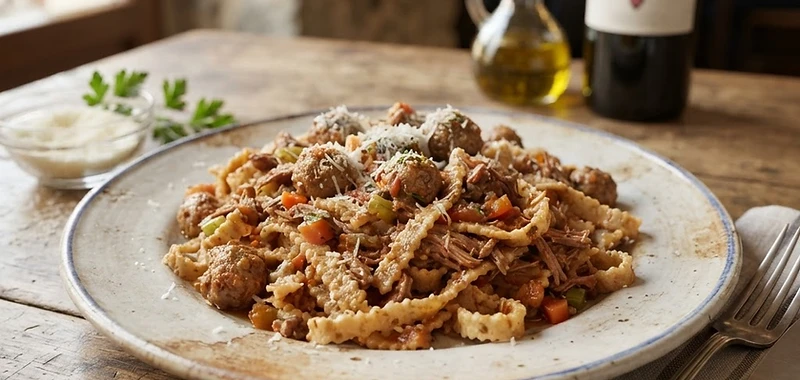
The pasta of Abruzzo, made on a 'chitarra' — a wooden frame strung with wire, like a guitar, that cuts the rolled dough into square-stranded noodles. Served three ways: with a tomato-and-meat ragù (alla teramana), with tiny meatballs (pallottine), or with white truffles. The square strand is the texture; the chitarra is the tool. Abruzzese comfort food, made with a tool that's a small piece of craft.
Why go
To eat pasta cut on a guitar-shaped frame — Abruzzo's signature, in three sauces.
The Field Guide take
Maccheroni alla chitarra is the definitive pasta of Abruzzo. It is defined by its method of production: a sheet of egg pasta is pressed through a wooden frame strung with steel wires, creating noodles with a distinctive square cross-section. In Abruzzo, this dish is not merely a menu item; it is a domestic tradition that bridges the gap between the coast of Pescara and the high pastures of the Apennines.
The Tool and the Texture
The dish takes its name from the chitarra (guitar) or carrature, the wooden frame that has been a standard tool in Abruzzese kitchens since the 19th century. While the technique of cutting pasta with wire has historical roots across central Italy, it reached its functional peak in the province of Chieti.
The square cross-section is the primary purpose of the tool. Unlike pasta extruded through bronze dies or cut with a smooth knife, the wire-pressed strand features a porous, slightly jagged surface. This texture is intentional; it is designed to grip the heavy, slow-cooked sauces that are characteristic of Abruzzese cuisine. When done correctly, the noodle provides a firm, consistent "al dente" bite that holds up against rich ragùs.
Production
The dough relies on a specific ratio of durum wheat semolina and fresh eggs. Because the pasta is meant to be pressed through metal wires, the dough must be kneaded until firm and allowed to rest sufficiently to develop its structure.
The process involves rolling the dough into a sfoglia—a sheet slightly thicker than those found in the egg-pasta traditions of Emilia-Romagna. The sheet is laid over the chitarra, and a rolling pin is used to press the dough downward. The wires slice through the sheet, and the resulting strands fall into the frame below. A critical mark of quality is the surface texture; machines that attempt to replicate this shape often produce a smooth, slippery noodle that fails to interact with the sauce as intended. In a traditional kitchen, the chitarra is a tool passed down through generations, and the proficiency of the maker lies in balancing the moisture of the dough so it cuts cleanly without sticking.
Regional Variations
How the pasta is served depends on where you are in the region. The most famous preparation comes from Teramo, where the pasta is served with a meat-based ragù and pallottine—tiny meatballs, typically no larger than a marble.
In the interior mountain regions around L'Aquila, the focus shifts to the landscape. Here, you are more likely to find the pasta finished with local mountain ingredients, such as wild mushrooms or shaved white truffles. While coastal areas occasionally serve the pasta with seafood, the meat-heavy preparations remain the standard bearer for the dish’s regional identity.
When and How to Eat
While you will find maccheroni alla chitarra on menus throughout the year, it is fundamentally a communal, labor-intensive food. It is most frequently encountered on Sundays and during major religious holidays like Christmas and Easter, when families dedicate the time required to hand-cut the pasta. If you are visiting a trattoria that prides itself on local custom, expect the pasta to be fresh; if the restaurant is a high-volume establishment, verify that the pasta is prepared on-site, as the quality difference between fresh, wire-cut pasta and dried or machine-pressed versions is significant.
The Pairing
The structure of this dish—particularly the meat-based ragùs—calls for the traditional wines of Abruzzo. A robust Montepulciano d'Abruzzo provides the necessary tannins and acidity to cut through the richness of the meat. For those who prefer a lighter approach or are dining on a summer afternoon, a Cerasuolo d'Abruzzo—a deep-colored, structured rosé—is the regional pairing of choice. Pecorino d'Abruzzo, a sheep’s milk cheese with a sharp, salty profile, is the standard finishing addition to the plate.
The Story
Where Maccheroni alla Chitarra comes from
Maccheroni alla chitarra is the defining pasta of the Abruzzo region. The dish takes its name from the 'chitarra' or 'carrature', a wooden frame strung with parallel steel wires resembling the strings of a guitar. Historical records suggest the tool emerged in the Chieti province during the 19th century, though similar pasta cutting techniques have existed in central Italy for centuries. It represents a transition from simple home-rolled dough to a more refined, structured noodle that retains sauce effectively due to its porous surface.
The pasta is deeply rooted in the agrarian culture of the Abruzzo Apennines. Because the noodles are cut on wire, they possess a distinct square cross-section, which creates a firmer 'al dente' texture than standard round-extruded or hand-cut pasta. The tool itself is a domestic artifact, often passed down through generations, and its use is synonymous with the preparation of Sunday family meals across the region, from the coast of Pescara to the mountainous interior of L'Aquila.
What Defines It
Signature ingredients
Durum wheat semolina
Provides the necessary structure and resistance to maintain the square shape after cutting.
Fresh eggs
Essential for the elasticity of the dough and the richness of the final noodle flavor.
Lamb or mutton ragù
The traditional meat base, reflecting the pastoral sheep-herding history of the Abruzzo mountains.
Pallottine
Tiny beef or pork meatballs, roughly the size of a marble, that characterize the most classic Abruzzese preparation.
The Method
How it's made
The dough is made from semolina and eggs, kneaded until firm, and rested. It is rolled into a sheet—the sfoglia—that is slightly thicker than that used for Northern Italian egg pastas. The sheet is laid across the wires of the chitarra, and the cook presses down with a rolling pin (mattarello), forcing the wires through the dough to create square-cut strands. A skilled maker ensures the dough is dry enough to avoid sticking but moist enough to stretch without tearing. Careless versions use machines to mimic the shape, which lacks the characteristic rough texture that allows the ragù to cling to the noodle, resulting in a slippery, inferior mouthfeel.
Across Italy
Regional variants
Teramo
Famous for the version served with tiny meat ragù and the iconic 'pallottine' (miniature meatballs).
L'Aquila
Often features the pasta finished with seasonal mountain ingredients like wild mushrooms or shaved white truffles.
Coastal Abruzzo
Variations may occasionally swap meat ragù for seafood-based sauces, though this is less traditional than the meat-heavy mountain recipes.
Timing
When to eat it
This is a year-round dish, though it is most frequently encountered during Sunday family gatherings and major holidays such as Christmas or Easter, where the labor-intensive preparation is standard practice.
Serve With
Classic pairings
Montepulciano d'Abruzzo
wineThe structured, earthy tannins of this local red are the essential match for the richness of lamb or meatball ragù.
Cerasuolo d'Abruzzo
wineA darker, cherry-toned rosato that offers enough acidity to cut through the egg-rich dough.
Pecorino d'Abruzzo
cheeseA grating of aged sheep milk cheese is the only appropriate finish, reflecting the local dairy tradition.
What makes it worth going
Egg pasta cut on a stringed frame, with a rich ragù — Abruzzo's signature pasta, in three sauces.
Things to do
- trattoria
A trattoria in L'Aquila or Teramo
The benchmark maccheroni alla chitarra, in the Abruzzo cities. The chitarra is the tool; the ragù is the sauce. Reserve.
2 hrs
- farm
An Abruzzo agriturismo
The chitarra is on the farm; the pasta is cut with the strings, the ragù is the family's. The farm is the source.
half day
- festival
A Sagra dei Maccheroni alla Chitarra
The village festivals in summer, where the chitarra is demonstrated in the square. The strings are the show.
full day
- experience
A chitarra-making class
The chitarra is a wooden frame with strings; the pasta is rolled, then pressed through the strings to cut it. The tool is the technique.
Eat
- pasta
Maccheroni alla chitarra al ragù
The classic: square-section egg pasta, cut with a chitarra (a wooden frame with strings), with a meat ragù (often lamb or pork, Abruzzo-style). The square section holds the sauce.
- dish
With pallotte cacio e uova
The Abruzzo companion: cheese and egg meatballs (often without meat), in a tomato sauce. The pasta and the pallotte are the table.
- wine
A glass of Montepulciano d'Abruzzo
The Abruzzo red; the correct pairing for the square pasta and the ragù.
Stay
- city
L'Aquila or Teramo
The Abruzzo bases, with good trattorias and easier access. A car is useful.
- farm-stay
An Abruzzo agriturismo
In the hills, where the chitarra is used on the farm. A car is required.
Experiences Worth Booking
Chitarra-making class
3 hrsThe chitarra, the dough, the cut. The square section is the technique.
The chitarra is a unique tool; a class shows you the strings, the press, and the square section that holds the sauce.
Suits: Pasta makers who want the Abruzzo tool; the chitarra is the secret.
Abruzzo food day
full dayA chitarra lunch, a scrippelle dinner, a Montepulciano cellar. The full Abruzzo arc.
The chitarra, the scrippelle, and the Montepulciano are the Abruzzo trinity; a day covers all.
Suits: Food travelers with a day for Abruzzo.
What's nearby & pairs with
More food from Abruzzo
Ready to plan?
Ready to turn discovery into a trip?
Italy Field Guide helps you decide where to go. When you're ready to build the actual day-by-day itinerary, take your saved places to Travel Itinerary Co — your interests go with you.
Turn your saved Italy places into a trip