
The Verdict
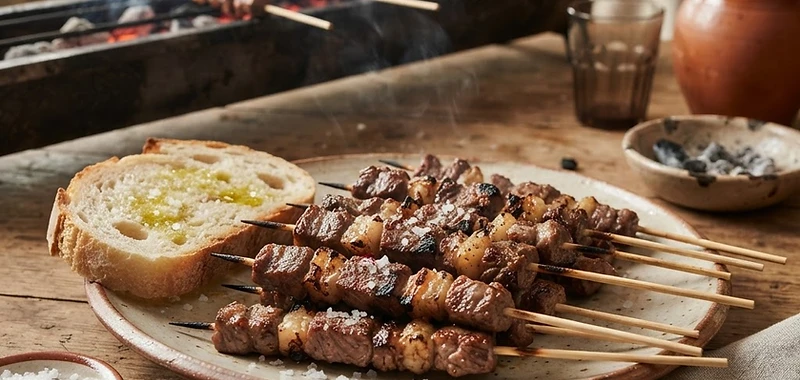
The snack of Abruzzo's shepherds, and the easiest great meat in Italy. Small skewers of mutton (castrato) — 1 cm cubes on a wooden stick — grilled over a narrow, long, sloping brazier (la fornacella) so the fat runs down and flavors the meat. Eaten by the dozen, with bread, a glass of Montepulciano d'Abruzzo, and not much else. The cheapest great meat in Italy, and one of the best.
Why go
To eat the cheapest great meat in Italy — tiny mutton skewers, by the dozen.
The Field Guide take
In the mountainous interior of Abruzzo, culinary culture is defined by necessity. Here, the landscape is dominated by the Gran Sasso and Majella massifs, terrain that historically dictated the movement of sheep and the habits of the men who tended them. Arrosticini—small skewers of mutton—stand as the primary artifact of this transhumance, representing a transition from humble shepherd’s sustenance to the region’s most distinct social meal.
What it is
Arrosticini are uniform cubes of mutton, each roughly one centimeter in size, threaded onto thin wooden sticks. The meat is purposefully alternated with small pieces of fat to ensure that, as the skewer cooks, the rendered fat drips back over the meat, keeping it moist and adding a characteristic richness. They are cooked over a fornacella, a specialized, narrow, rectangular charcoal grill that allows the meat to hover directly over the heat while keeping the wooden handles cool. They are rarely served as a single-portion entrée; they are ordered by the dozen and eaten with little else beyond crusty bread and wine.
Origin and history
The dish emerged from the economic realities of shepherding. When sheep reached an age where they were no longer productive for milk or wool, they were culled. This meat—known as castrato—is lean, muscular, and notoriously tough. To make it edible, shepherds cut the meat into tiny, uniform pieces, which cooked rapidly over an open flame, providing a high-protein meal that required almost no cooking equipment. While the dish originated in the remote pastures of the interior, it migrated toward the province of Pescara and the town of Farindola by the mid-20th century. What began as a nomadic survival tactic eventually moved from rural firesides into commercial kitchens, solidifying its place as the centerpiece of Abruzzese social gatherings.
How it's made
The quality of an arrosticino rests on the ratio of meat to fat and the precision of the cook. A proper version is hand-cut; mechanical cutting, while faster, often damages the integrity of the muscle fibers. The charcoal must be at high intensity, providing the heat necessary to crisp the exterior fat while leaving the interior tender. The skewers require constant attention, flipped frequently to achieve a light char without drying out the meat. Because the mutton itself is flavorful, the only required seasoning is coarse sea salt, applied while the meat is on the grill. If the meat is under-salted or the grill lacks the specific narrow dimensions of the fornacella, the fat fails to render correctly, leading to a dry or chewy experience.
Regional variations
There is a noted distinction between the rural interior and the coastal hubs. In towns like Farindola, the technique remains tethered to tradition: strictly hand-cut meat with a focus on the specific texture of mature mutton. As one moves toward the Pescara coast, the product is often more commercialized. Here, vendors may use younger lamb, which results in a milder, less aggressive flavor, or use larger skewers that stray from the traditional proportions. While these coastal variants remain popular, they are often seen by purists as a dilution of the specific, gamey character of the mountain original.
Where to eat it
Arrosticini are fundamentally tied to outdoor communal dining. Throughout the summer months, sagre (food festivals) across Abruzzo serve as the most authentic venues for the dish. In these settings, the grills are operated by locals who understand the specific heat requirements of mutton. When dining in a permanent restaurant, look for establishments that advertise fatto a mano (hand-made) skewers, which indicates the meat was butchered and threaded on-site rather than sourced as a frozen industrial product.
When and how
While arrosticini are available year-round, they are best sought out during the warmer months when they can be consumed in the open air. The etiquette is simple: you will be served a large bundle of skewers in a tall vessel, often wrapped in foil to retain heat. Eat them with your hands, sliding the meat off with your teeth. It is customary to accompany the meat with slices of bread drizzled with local olive oil, which serves to absorb the rendered fat.
What to drink with it
The intensity of the mutton requires a wine with significant structure and acidity to cut through the fat. The classic choice is Montepulciano d'Abruzzo, a red wine with deep tannins that stands up well to the char of the grill. For those who prefer a lighter approach, Cerasuolo d'Abruzzo—a vibrant, cherry-colored rosé made from the same Montepulciano grape—is widely considered the perfect pairing, offering enough body to match the protein while providing the crisp acidity needed to refresh the palate between skewers.
The Story
Where Arrosticini comes from
Arrosticini originated in the mountainous interior of Abruzzo, specifically within the Gran Sasso and Majella massifs. Historically, the dish emerged from the transhumance culture, where shepherds moved flocks between the Abruzzese mountains and the plains of Puglia. When older sheep—those no longer productive for milk or wool—were culled, the tough, lean meat needed a way to be prepared that made it palatable and efficient for nomadic life. Using small, uniform cubes allowed the meat to cook rapidly over an open flame, providing a high-protein meal that could be prepared with minimal equipment while tending to flocks in remote pastures. It evolved from a subsistence survival food into a defined cultural staple centered around the province of Pescara and the town of Farindola. By the mid-20th century, the dish transitioned from rural firesides to restaurants, becoming a focal point of Abruzzese social gatherings.
What Defines It
Signature ingredients
Castrato (Mutton)
The primary ingredient, typically from castrated sheep, providing the deep, gamey flavor profile that distinguishes it from younger lamb.
Animal Fat
Interleaved with the meat on the skewer, it is essential for basting the cubes during the intense grilling process to prevent the meat from drying out.
Coarse Sea Salt
The only seasoning traditionally used, applied liberally after grilling to enhance the natural salinity of the mutton.
Abruzzese Bread
Typically stale or toasted, used to soak up the residual fat and juices released during consumption.
The Method
How it's made
The meat is cut into uniform 1-centimeter cubes and threaded onto thin wooden skewers, alternating lean meat with small pieces of fat. The crucial piece of equipment is the fornacella, a long, narrow, rectangular charcoal grill designed specifically to suspend the skewers over the heat while keeping the wooden handles away from the fire. A quality version relies on intense, concentrated charcoal heat; the skewers are flipped frequently to ensure the fat renders and coats the meat, resulting in a exterior that is slightly charred and crisp, while the interior remains tender. A careless version is often under-salted, lacks the specific ratio of fat required to achieve a crust, or utilizes inferior, overly lean cuts that dry out rapidly.
Across Italy
Regional variants
Farindola
Often credited with the traditional technique of using strictly hand-cut meat, which maintains a superior texture compared to machine-cut cubes.
Pescara Coast
Features larger, more commercialized versions that are sometimes pre-seasoned or use a higher percentage of younger lamb for a milder flavor profile.
Timing
When to eat it
Arrosticini are consumed year-round in Abruzzo, though they are most closely associated with warm-weather outdoor dining and sagre (food festivals) throughout the summer months when communal grilling is most common.
Serve With
Classic pairings
Montepulciano d'Abruzzo
wineThe tannins and acidity of this local red wine cut through the high fat content of the mutton.
Pane con Olio
foodRustic bread drizzled with high-quality local extra virgin olive oil, commonly served as the standard starch accompaniment.
Cerasuolo d'Abruzzo
wineA chilled, darker rosé that provides a refreshing contrast to the smoke of the charcoal grill.
What makes it worth going
Tiny skewers of mutton, grilled over a long channel — Abruzzo's shepherd snack.
Things to do
- experience
A roadside grill in the Pescara hills
The most authentic arrosticini: a narrow channel grill (fornacella) on the side of the road, by the dozen, with bread. The fat runs down and flavors the meat.
1 hr
- butcher
Macelleria Mosca (Pescara)
The legendary Abruzzo butcher, since 1950. Buy arrosticini to grill; or eat at the butcher's grill, if it's open.
45 min
- osteria
A hill town osteria (e.g. Pacentro, Rocca Calascio)
In the hill towns above Pescara, the arrosticini are grilled at the door. The view is the reason; the skewers are the meal.
2 hrs
- experience
The shepherds' transhumance routes
The old sheep tracks (tratturi) that cross Abruzzo. In summer, the flocks go to the high pastures; the arrosticini are grilled at the arrival.
Eat
- main
Arrosticini (by the dozen)
Tiny mutton skewers, 1-cm cubes on a wooden stick, grilled over a narrow channel. Eaten by the dozen, with bread, oil, and a Montepulciano d'Abruzzo.
- bread
Pane casareccio
Abruzzo's dense, salted country bread. The vehicle for the fat and the oil.
- wine
Montepulciano d'Abruzzo
The correct red; the cheap, generous Abruzzo red that the shepherds drink with the skewers.
Stay
- city
Pescara
The coast base; near the best butchers and grills. The most convenient base.
- rural
A hill town (Pacentro, Sulmona, Rocca Calascio)
In the mountains, with the views. The most authentic Abruzzo; a car is required.
Experiences Worth Booking
Arrosticini grill at a high pasture
half dayA drive to a shepherd's hut, arrosticini grilled on a fornacella, bread, oil, wine. The full pastoral meal.
The fornacella and the mutton are the secret; the high pasture is the context you can't get in a restaurant.
Suits: Meat lovers who want the most authentic Abruzzo.
Abruzzo wine and arrosticini day
full dayA Montepulciano d'Abruzzo winery visit, an arrosticini lunch, a hill town. The full Abruzzo arc.
The red and the skewers are the Abruzzo pairing; a guided day covers the cellar and the grill.
Suits: Wine and meat lovers with one day for Abruzzo.
What's nearby & pairs with
More food from Abruzzo
Ready to plan?
Ready to turn discovery into a trip?
Italy Field Guide helps you decide where to go. When you're ready to build the actual day-by-day itinerary, take your saved places to Travel Itinerary Co — your interests go with you.
Turn your saved Italy places into a trip