
The Verdict
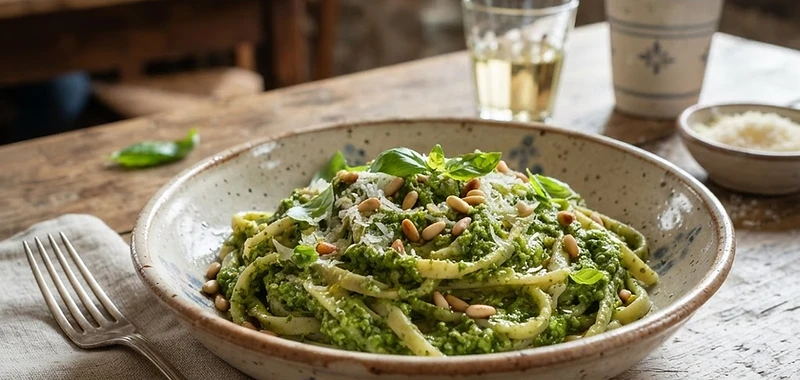
The sauce that made Liguria famous. Basil from Pra (the Genoese district), pine nuts, garlic, Parmigiano, pecorino, and Ligurian olive oil, traditionally pounded in a marble mortar. Served with trofie (twisted pasta), trenette, or with potatoes and green beans. The jarred version is fine; the fresh-pounded version in Genoa is a different thing entirely.
Why go
To taste pesto at its source, where the basil is grown and the mortar is still used.
The Field Guide take
Pesto alla Genovese is the definitive sauce of Liguria. While it has become a global staple, its character is tied specifically to the environment of Genoa and the coastal hills that rise sharply from the Mediterranean. Unlike most Italian sauces, which rely on heat to marry flavors, pesto is a raw emulsion. Its quality depends entirely on the freshness of the basil and the mechanical force used to break down the ingredients.
What it is
Pesto is a raw, pounded sauce composed of basil, pine nuts, garlic, hard cheese, and olive oil. In its purest form, it is an intense, fragrant paste. Because it is never cooked, the basil retains a bright, grassy profile that is significantly more aggressive than the dried or heated herbs found in other sauces. The texture should be creamy but distinct, with the oils from the nuts and the cheese providing a bridge between the sharp bite of raw garlic and the floral notes of the basil.
Origin and history
The sauce emerged from the maritime culture of Genoa. Liguria’s geography—narrow, steep coastal strips backed by mountains—limited the space for large-scale agriculture, forcing inhabitants to rely on what could be grown in small, terraced plots or sourced through trade. Basil, which thrives in the Mediterranean sun, became a staple crop in the district of Pra'. Pesto as we recognize it today began to solidify in the mid-19th century, drawing on the region's access to high-quality olive oil and the availability of imported goods like pine nuts. It remains a testament to the local ability to extract maximum flavor from a handful of simple ingredients.
How it’s made
The canonical preparation requires a marble mortar and a wooden pestle. While food processors are common, the heat generated by fast-spinning steel blades often oxidizes the basil, turning it brown and muting its aroma. Pounding by hand creates a different result: it crushes the basil leaves against the marble, releasing the essential oils into the mixture rather than shredding them.
The process begins by grinding the garlic into a cream, followed by the pine nuts. Once these are integrated, the basil leaves are added, pounded with a circular motion. Finally, the cheeses—typically a blend of aged Parmigiano Reggiano and Pecorino Sardo—are folded in, followed by a steady stream of Ligurian extra virgin olive oil. This oil is distinct from those produced in Tuscany or the south; it is famously mild, golden, and buttery, ensuring it does not overwhelm the delicate flavor of the basil.
Where to eat it
If you are in Genoa, look for trattorias that explicitly mention the use of a mortaio (mortar) in their kitchen. The sauce is traditionally served with trofie, a small, twisted pasta shape that is excellent at trapping the thick sauce, or trenette, a thin, flat ribbon. In the city, you will often find it served in the classic regional style: with small cubes of potato and blanched green beans tossed into the pasta water alongside the noodles. This addition is not a garnish; it is a structural part of the meal that balances the potency of the garlic.
When and how
Basil is a summer crop. While it is possible to find pesto year-round, the flavor is at its peak between June and August when the basil is harvested under the intense Ligurian sun. Because the sauce is a raw emulsion, it is sensitive to heat. It should never be added to a pan over the fire. Instead, the pesto is stirred into the pasta in a serving bowl, using a tablespoon of the starchy, hot pasta water to loosen the consistency into a silky coat.
What to drink with it
Pesto is a high-fat, high-intensity dish that can easily make a heavy red wine taste metallic. It requires a white wine with high acidity and a clean, mineral finish to cut through the oil and cheese. The local choice is Vermentino, grown in the coastal vineyards of Liguria. Its citrus notes and saline edge mirror the Mediterranean environment where the basil was grown. If you prefer something else, look for a dry, crisp white from a coastal region, but avoid wines with heavy oak influence, as the wood tannins will clash with the fresh herbs.
The Story
Where Pesto alla Genovese comes from
Pesto alla Genovese is the green heart of Ligurian cooking, born from the abundant basil grown in the coastal hills. It is a raw sauce, meaning the ingredients are never cooked, keeping the flavor of the basil incredibly vibrant. It represents the maritime history of Genoa, using ingredients gathered from the nearby hills.
What Defines It
Signature ingredients
Genovese basil
Smaller and sweeter than standard varieties, it is essential for the flavor.
Pine nuts
Provide a creamy, nutty base to thicken the emulsion.
Ligurian olive oil
Light, fruity, and non-bitter, it rounds out the herb flavor.
The Method
How it's made
Traditionally pounded by hand in a marble mortar with a wooden pestle. This technique prevents oxidation, keeping the basil bright green and the texture perfectly creamy.
Across Italy
Regional variants
Liguria
Some variations use a mix of Parmigiano and Pecorino for more depth.
Timing
When to eat it
Summer
Serve With
Classic pairings
Vermentino
wineThe quintessential Ligurian white, herbaceous and refreshing.
Trenette
foodThe classic pasta shape, often served with potatoes and green beans.
What makes it worth going
Basil, pine nuts, garlic, Parmigiano, pecorino, and olive oil, pounded into a paste — the sauce of Genoa.
Things to do
- trattoria
Trattoria da Maria
In the caruggi (the old narrow streets), since 1880. The pesto is the benchmark; the trofie is hand-rolled. Cash only, queue at lunch.
1.5 hrs
- trattoria
Sa Pesta
In the historic center, near the port. The pesto is correct, the focaccia is the starter, the farinata is the rival.
1.5 hrs
- ristorante
Il Genovese
The refined version, with the pesto made to order. The most deliberate in the city.
2 hrs
- festival
The pesto championship (Palazzo Ducale, April)
The world pesto championship, every two years in Genoa. 100 pesto-makers, one city. The atmosphere is the show.
Eat
- pasta
Trofie al pesto
The classic: hand-rolled twisted pasta, basil pesto (basil, pine nuts, garlic, pecorino or parmesan, olive oil), potato and green beans. The potato and beans are the Genoese touch.
- pasta
Mandili de saea al pesto
The 'silk handkerchiefs' — thin sheets of egg pasta with pesto. The most delicate version.
- bread
Focaccia genovese
The starter and the companion; the salty, oily flatbread of Genoa. Eat it with the pesto, or before.
Stay
- neighborhood
Centro Storico (caruggi)
In the old narrow streets, near the best trattorias and the pesto. The most authentic Genoese base.
- neighborhood
Boccadasse
The old fishing village, now part of the city; quieter, seafront, with good trattorias.
Experiences Worth Booking
Pesto-making class with a mortar
2 hrsLearn to make pesto with a marble mortar and a wooden pestle — the authentic method. The basil is from Genoa, the pine nuts are Italian.
The mortar bruises the basil rather than cutting it; the flavor is different, and a class shows you the technique.
Suits: Anyone who has only made pesto in a blender; the mortar is the secret.
Genoa food walk
3 hrsFocaccia, farinata, pesto, cappon magro. The full Genoese circuit in the caruggi.
Genoa's food is in the narrow streets; a walk finds the focaccia ovens and the pesto trattorias.
Suits: Eaters who want the old city and its food.
What's nearby & pairs with
More food from Liguria
Ready to plan?
Ready to turn discovery into a trip?
Italy Field Guide helps you decide where to go. When you're ready to build the actual day-by-day itinerary, take your saved places to Travel Itinerary Co — your interests go with you.
Turn your saved Italy places into a trip