
Cheese · Liguria
Bruzzu
The Verdict
Bruzzu is the strangest cheese in Liguria and one of the hardest to buy: a small producer's cheese, fermented in whey, eaten with oil and bread or stirred into polenta. If you find it in a village shop inland from Imperia, buy it.
Why go
The Intemelian hills behind the Riviera, where olive terraces and sheep still share the slopes.
The Field Guide take
Bruzzu is the most singular cheese in Liguria. It is rarely exported beyond the province of Imperia, and even within the region, it remains a peripheral product of small-scale pastoralism. Expect a fermented, pungent, and spreadable cheese that lacks the uniformity of commercial dairy. It is a product of the hinterland, where the proximity to the coast meets the rugged, steep geography of the Ligurian Alps.
Character and Provenance
Bruzzu is a product of necessity. In the hills behind the Riviera, where grazing land is fragmented by steep, man-made olive terraces, sheep have long provided the primary source of milk. Without the infrastructure for long-term aging or reliable refrigeration, local producers turned to fermentation as a preservation method.
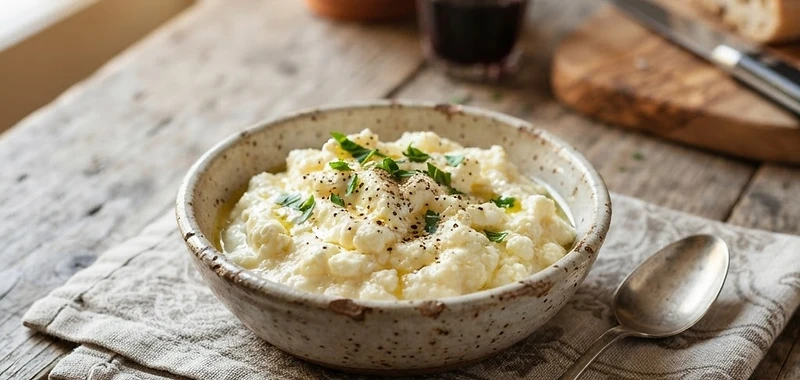
The result is a cheese that defies standard categories. It is not a firm, sliceable wheel, nor is it a mild fresh cheese. Bruzzu is a semi-liquid, fermented paste with a high acidity and a sharp, often aggressive, tang. It varies in texture from thick cream to a looser, spoonable consistency depending on the specific batch and the length of the fermentation process. It is the definition of a farmhouse product: volatile, earthy, and impossible to replicate in an industrial setting.
Production Methods
The cheese is crafted from ewe's milk. Once curdled, the curd is broken into small particles. Unlike other traditional cheeses where the curd is drained and pressed, Bruzzu remains submerged in its own whey. This lingering contact is what defines the flavor profile. Over time, the mixture undergoes a natural fermentation process within the whey, which breaks down the proteins and develops the sharp, fermented profile. Because it is produced in small, artisanal batches by shepherds, the final product is heavily influenced by the specific flock’s diet and the ambient temperature of the local dairy space.
Finding the Cheese
Bruzzu is not a supermarket staple. To find it, one must leave the coastal towns and travel into the Intemelian hinterland—the valleys winding inland from Ventimiglia, Bordighera, and Sanremo. Small, family-run alimentari in mountain villages are the most likely sources. It is not always on display; asking a shopkeeper if they have a local formaggio fermentato or specifically naming Bruzzu is often necessary. Because production is tied to the movement of the flocks, it is primarily available in the spring and autumn months. If a shop has it, the quantity is usually limited, and freshness is paramount.
Serving and Pairing
Bruzzu is intended to be eaten in small quantities as a garnish or a flavor intensifier. The classic local approach is to spread it on thick slices of crusty, unsalted sourdough bread. To temper the sharp acidity, it is customary to drizzle a generous amount of high-quality Taggiasca olive oil over the top. The oil adds a necessary fat content and fruitiness that balances the fermented bite of the cheese.
Another traditional application is to stir a spoonful into warm polenta. The residual heat of the cornmeal softens the cheese further, allowing it to coat the grains and add a complex, tangy dimension to a simple dish. It is not a cheese to be eaten in large portions, but rather used as a forceful, savory accent.
Wine Considerations
The intensity of Bruzzu requires a wine with enough structural integrity to hold its own. The canonical pairing is Rossese di Dolceacqua, the red wine produced from vineyards in the very same hills where the sheep graze. A light, aromatic red with moderate tannins and a peppery finish, Rossese manages to navigate the cheese’s pungent acidity without being overwhelmed. Avoid delicate or high-alcohol white wines, which will clash with the fermentation notes. If a local wine is unavailable, focus on light, dry reds from the nearby Piedmontese border, which share a similar approach to earth-driven profiles.
Expect variation. If a jar of Bruzzu from one village tastes different than one from the next valley over, the production process is functioning exactly as intended.
The Story
Where Bruzzu comes from
The cheese comes from the pastoral economy of the Ligurian hinterland, where flocks grazed between olive terraces and the coast and milk had to be preserved without refrigeration.
The Method
How it's made
Ewe's milk is curdled, the curd is broken and left in the whey to ferment, which gives the strong flavor and soft texture. It is made in small batches and sold locally.
Timing
When to eat it
Made in spring and autumn when the flocks are milking.
Serve With
Classic pairings
Rossese di Dolceacqua DOC
wineTaggiasca olive oil
produceWhat makes it worth going
A sheep's cheese left to ferment in its own whey in the hills behind the Riviera — sharp, runny, and hard to find.
What's nearby & pairs with
More food from Liguria
Ready to plan?
Ready to turn discovery into a trip?
Italy Field Guide helps you decide where to go. When you're ready to build the actual day-by-day itinerary, take your saved places to Travel Itinerary Co — your interests go with you.
Turn your saved Italy places into a trip