The Verdict
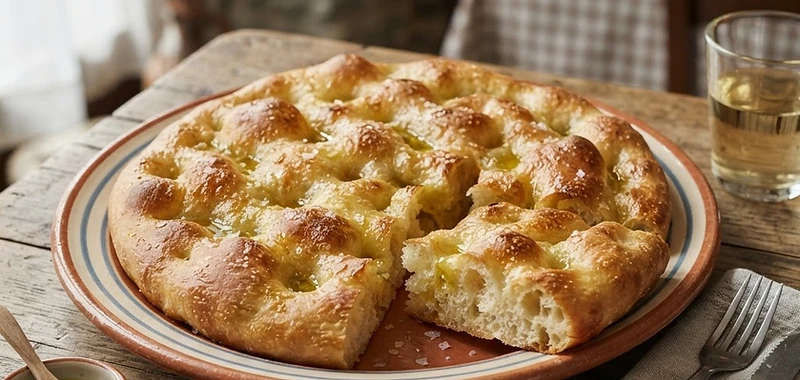
The bread of Genoa, eaten morning, noon, and night. A high-hydration dough, dimpled with fingers, drenched in olive oil and salt, and baked until the top is golden and the inside is custardy. Eat it plain, with cheese, or split and filled with stracchino. The Genoese eat it for breakfast with a cappuccino — don't judge.
Why go
To eat focaccia at its best, in the city that invented the version everyone copies.
The Field Guide take
Focaccia Genovese is the baseline of life in Genoa. It is not a specialty reserved for holidays or tourist tables; it is the everyday bread of the Ligurian capital, found in nearly every bakery and consumed with total frequency from dawn until night. To walk through the city is to smell the distinct combination of toasted flour, high-quality olive oil, and coarse sea salt emanating from ovens at every street corner.
What it is
Focaccia Genovese is a flatbread characterized by a golden, crisp exterior and an airy, tender crumb. Its most identifiable feature is the surface, which is covered in deep, irregular dimples created by the baker’s fingertips. These pockets serve a functional purpose: they hold a significant volume of olive oil and coarse sea salt, ensuring that every bite is savory and rich. While the rest of Italy produces various types of focaccia, the Genoese version is notably higher in hydration, resulting in a texture that leans more toward a custard-like softness at its center than a dry or cracker-like crunch.
Origin and history
The history of focaccia in Liguria dates back centuries, rooted in the trade-heavy culture of Genoa. As a major maritime republic, the city had ready access to high-quality olive oil, which became the defining ingredient of its diet. While the term "focaccia" (derived from the Latin focus, meaning hearth) describes a wide family of flatbreads found across the Mediterranean, the Genoese style evolved as a staple for dockworkers and sailors who required a calorie-dense, portable food. Over time, the production moved from home hearths into the professional bakeries, or panifici, that now dominate the urban landscape of Genoa.
How it’s made
The quality of Focaccia Genovese relies on three factors: flour, oil, and time. The dough is made from a strong bread flour and is fermented for several hours to allow for a complex, developed flavor. Before baking, the dough is stretched into a rectangular pan and left to rise again. The hallmark step involves the baker pressing their fingers deeply into the dough, creating the signature dimples.
Before the tray hits the oven, a brine—a mixture of water, salt, and generous amounts of extra virgin olive oil—is poured over the surface. This liquid collects in the dimples, preventing the bread from drying out during the intense heat of the bake. A successful bake produces a deep golden-brown top crust and a crisp, fried underside, while the interior remains soft and moist.
Where to eat it
If you are looking for authentic Focaccia Genovese, the province of Genoa is the only place to start. Within the city center, prioritize independent panifici over mass-market chains. A reliable indicator of quality is a subtle sheen of olive oil on the surface and a consistent, airy crumb structure. Avoid any focaccia that looks pale, dry, or sits under heat lamps for extended periods. Most high-quality bakeries sell it by weight; a simple square is standard, but you may also encounter "focaccia di Recco," a different, cheese-filled variety found in the nearby coastal town of Recco that should not be confused with the classic Genoese version.
When and how
In Genoa, time of day is irrelevant to the consumption of focaccia. It is perfectly acceptable to eat a slice of plain focaccia as a mid-morning snack, a lunch substitute, or an afternoon treat. The local custom of dipping a piece into a morning cappuccino is a common sight in Genoese cafes; the saltiness of the bread pairs with the bitterness of the coffee in a way that is surprising to outsiders but foundational to the locals. You can eat it plain, or ask for a slice filled with stracchino, a mild, creamy cow's milk cheese that melts slightly against the residual heat of the bread.
What to drink with it
Because the bread is so inherently oily and salty, the ideal accompaniment is a beverage that cuts through the richness. If you are eating it as a light lunch, a glass of Pigato—a white wine native to the Ligurian Riviera—is the canonical choice. Its bright acidity and herbal, mineral notes balance the dense oil of the dough. If you are drinking in the morning, a simple cappuccino remains the standard, though a glass of sparkling water or a light white wine is equally effective at refreshing the palate between bites.
The Story
Where Focaccia Genovese comes from
Focaccia Genovese is the ubiquitous snack of Genoa, found in every bakery and eaten at all hours. It is defined by its deep, dimpled surface and the generous use of olive oil and salt. The dough is fermented and baked until it achieves a specific crunch, contrasting with the soft, oil-rich center.
What Defines It
Signature ingredients
High-quality olive oil
Used in the dough and as a final splash for flavor and moisture.
Coarse sea salt
Provides the essential crunchy contrast to the soft dough.
Bread flour
Gives the dough enough strength to hold its structure during long rises.
The Method
How it's made
The dough is dimpled with fingertips before baking to create pools for olive oil and salt. A good version is soft, airy, and intensely savory with a crisp bottom crust.
Timing
When to eat it
Year-round
Serve With
Classic pairings
Pigato
wineAn aromatic Ligurian white that stands up to the salty crust.
Cappuccino
foodThe local way to eat it for breakfast, dipped directly into the coffee.
What makes it worth going
Olive-oil-rich flatbread, dimpled, salted, and baked until golden — the everyday bread of Genoa.
Things to do
- focacceria
Focaccia da Salvatore
In the Recco zone (the focaccia capital). The focaccia di Recco (with stracchino cheese) is the other focaccia; the plain is the daily.
1 hr
- focacceria
Focacceria in the caruggi (Genoa)
Any of the small ovens in the old streets. The focaccia is by the slice, warm, eaten standing. The test is the salt and the oil.
20 min
- day trip
Recco, on the coast
The home of focaccia di Recco (the cheese-filled version). A day trip from Genoa, by train or car, with a focaccia lunch.
- experience
A focaccia oven tour
The ovens of the Riviera di Levante, from Recco to Camogli. The focaccia changes by town; the tour shows the differences.
Eat
- bread
Focaccia genovese (plain)
The classic: a flat, oily, salty focaccia, dimpled, baked in a pan. Eaten warm, by the slice, for breakfast or a snack.
- bread
Focaccia di Recco
The other focaccia: two thin sheets of dough, filled with stracchino cheese, baked until blistered. The IGP version; eat it in Recco.
- bread
Focaccia con le cipolle
The focaccia with onions, the savory version. A breakfast food in Genoa, with coffee.
Stay
- neighborhood
Genoa center (caruggi)
Near the ovens and the focaccia. The most authentic base.
- coastal town
Camogli
A pretty Riviera town, near Recco; the focaccia di Recco is as good, the view is the bonus.
Experiences Worth Booking
Focaccia-making class
3 hrsThe dough, the dimpling, the oil, the bake. Often in a working oven, early in the morning.
The focaccia is 80% technique; a class in an oven shows you the dough hydration and the dimple.
Suits: Bread bakers who want the technique; the oil and the dimple are the secret.
Riviera di Levante food day
full dayRecco for the focaccia, Camogli for the pesto, Portofino for the view. The full Riviera arc.
The focaccia and the pesto are both from this coast; a day covers both.
Suits: Travelers with a day for the coast east of Genoa.
What's nearby & pairs with
More food from Liguria
Ready to plan?
Ready to turn discovery into a trip?
Italy Field Guide helps you decide where to go. When you're ready to build the actual day-by-day itinerary, take your saved places to Travel Itinerary Co — your interests go with you.
Turn your saved Italy places into a trip