Cheese · Calabria
Pecorino Crotonese
The Verdict
Crotonese is the everyday cheese of eastern Calabria and the one to buy if you are driving that coast. Young it is elastic and slightly sour; aged it becomes hard and peppery and grates over pasta. It is almost unknown outside the region.
Why go
Shepherd country above the Ionian, with cheese sold at farm gates and in village markets.
The Field Guide take
Pecorino Crotonese defines the culinary landscape of the eastern Calabrian hills. While much of Italy’s sheep’s milk cheese production is dominated by the massive output of Sardinia or the central regions, this cheese remains tethered to the province of Crotone. It is the definitive cheese of the Ionian coast, and for those traveling through the territory, it is the most reliable marker of the local palate. Seek this out in the interior hill towns behind the coast; do not confuse it with the softer, younger cheeses found further north in the Sila mountains or near Cosenza.
What it is
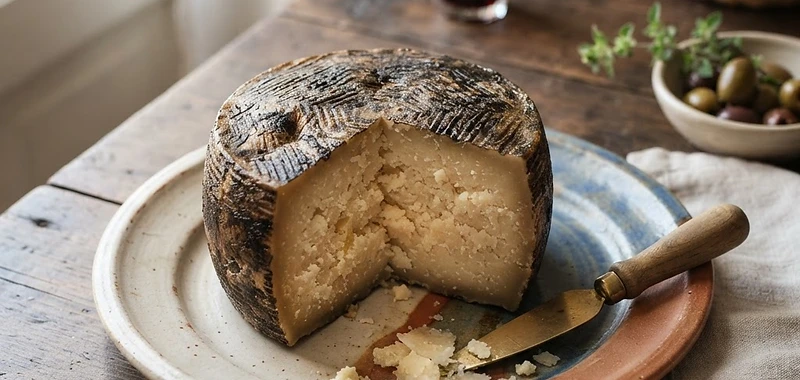
Pecorino Crotonese is a raw ewe’s milk cheese produced in two distinct stages. When young—aged for about two months—it is semi-soft, pale, and carries a sharp, lactic tang. As it ages toward a year, it hardens significantly, darkening to a straw-yellow hue. The rind is firm, and the texture becomes brittle and crystalline. The flavor profile is defined by the rugged, wild-herb pastures of the Ionian hinterland. It is not a subtle cheese; it is pungent, peppery, and intensely salty.
Origin and history
The practice of shepherding in the Crotone hinterland predates modern borders, relying on the ancient transhumance routes that moved flocks between the Ionian coast and the higher reaches of the Sila plateau. The cheese is a product of these small-scale, mobile flocks. Unlike industrial cheeses that prioritize consistency, Crotonese varies by the season and the specific grazing plot of the flock. It is a traditional survival food, preserved through salting and long aging to sustain families through winter months when milk production ceases.
How it's made
Production begins with ewe’s milk curdled using lamb rennet. The curd is pressed by hand into traditional reed baskets, known as fuscelle. These baskets give the cheese its characteristic ribbed exterior pattern. After the whey is drained, the wheels are salted—either dry-salted or brine-soaked. For the wheels destined for long aging, producers coat the exterior with a mixture of olive oil and vinegar. This treatment protects the cheese while it rests in cool, stone-walled cellars, allowing the enzymes to break down the proteins into the concentrated, sharp profile desired for grating.
Where to eat it
The best cheese is found at the source. Drive inland from Crotone toward towns like Santa Severina or Mesoraca. Look for signs pointing to caseifici (dairies) or aziende agricole. These small producers often sell wheels directly from a farmhouse kitchen or a dedicated storefront attached to the barn. In the city of Crotone, visit the municipal markets in the early morning. If you are dining out, ask for a cheese board featuring only local products. If a restaurant serves a pre-cut, factory-wrapped wedge, ask if they have a "stagionato" (aged) wheel from a local producer instead.
When and how
Spring is the peak of the production cycle, as the milk is richest when the sheep graze on fresh, post-winter grasses. However, because the cheese is aged, it is available year-round. Consume the young, semi-soft variety sliced thinly alongside crusty local bread and olives. Reserve the hard, long-aged variety for grating. It is the standard finish for southern pasta dishes, particularly those featuring tomato-based sauces or robust vegetable ragùs. It should be served at room temperature; remove it from the refrigerator at least thirty minutes before eating to allow the fats to soften.
What to drink with it
Calabria’s viticulture centers on the Gaglioppo grape, and nowhere is this more evident than in the Cirò DOC zone, which sits just north of Crotone. A medium-bodied, tannic Cirò Rosso provides the necessary structure to stand up to the high salt content and intense sheep-milk fat of the Crotonese. For the younger, softer version of the cheese, a crisp Cirò Bianco—often made from the Greco Bianco grape—cuts through the lactic acidity. Avoid delicate or high-acid white wines, which will be completely overwhelmed by the cheese's peppery finish.
The Story
Where Pecorino Crotonese comes from
The cheese has been made in the hills behind Crotone for centuries, and the basket-pressed form is shared with other southern pecorini. Production is small and mostly local.
The Method
How it's made
Ewe's milk is curdled with lamb rennet, pressed into reed baskets, salted, and aged for two months or a year. The long-aged forms are rubbed with oil and vinegar.
Timing
When to eat it
Spring milk gives the best cheese.
Serve With
Classic pairings
Cirò DOC
wine'Nduja
cured meatWhat makes it worth going
A hard sheep's cheese from the hills above the Ionian coast, pressed in woven baskets and aged for grating.
What's nearby & pairs with
More food from Calabria
Cheese
Caciocavallo Silano
The stretched-curd cheese of the Sila plateau, hung in pairs and eaten fresh or grilled.
Cured Meat
Soppressata di Calabria
Spicy, pressed pork salami from Calabria — the south's great cured meat, with chili.
Cured Meat
'Nduja
Spreadable, fiery fermented pork sausage from Calabria — the south's most explosive cured meat.
Ready to plan?
Ready to turn discovery into a trip?
Italy Field Guide helps you decide where to go. When you're ready to build the actual day-by-day itinerary, take your saved places to Travel Itinerary Co — your interests go with you.
Turn your saved Italy places into a trip