
Cheese · Calabria
Caciocavallo Silano
The Verdict
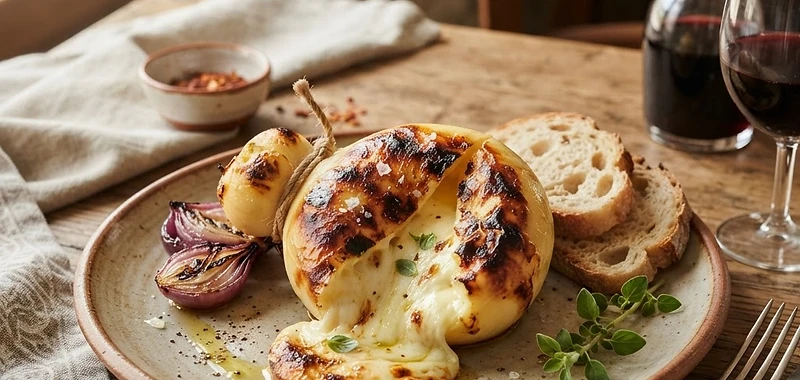
Silano is the best caciocavallo in Italy and the one with a real terroir, made on a plateau of pine forest and pasture. Grilled over embers until the outside blisters, it is the single best thing to eat in the Calabrian mountains.
Why go
A high plateau of pine and pasture with dairies along the roads, in a part of Calabria almost no one visits.
The Field Guide take
The Sila plateau is an alpine landscape at odds with the typical Calabrian narrative of heat and coastline. It is a high-altitude territory of granite, pine forests, and high-mountain pasture. Here, the defining product is Caciocavallo Silano. This is a stretched-curd cheese that justifies the journey into the interior of Cosenza and Catanzaro. When grilled over open embers, the fat renders and the exterior blisters, creating a profile that justifies its status as the most characterful cheese in the region.
What it is
Caciocavallo Silano is a semi-hard cow’s milk cheese defined by its distinctive shape: a teardrop or gourd body with a small "head" at the top, tied in pairs with twine and hung from wooden beams to age. While the name caciocavallo appears elsewhere in Italy, the Silano designation is protected and localized to the plateau. The texture ranges from supple and buttery when young to sharp, firm, and crystalline when aged for six months or longer.
Origin and history
The history of this cheese is tied to the movement of shepherds through the Sila. The production methods were refined over centuries, shaped by early Greek-descended communities and later by the Arbëreshë people, who moved into the Calabrian interior and maintained strict transhumance patterns. The plateau remains the primary site of production. The geography creates a specific terroir; the milk is influenced by high-altitude flora that does not exist in the valley or along the Mediterranean coast.
Production techniques
The process relies on the manipulation of curd in hot whey. Producers heat cow’s milk and add rennet to form the curd. Once firm, the mass is cut and left to acidify. The defining stage is the filatura: the curd is submerged in near-boiling whey and worked by hand until it becomes an elastic, smooth paste. The cheesemaker pulls and shapes the paste into its characteristic gourd form, seals the bottom, and ties two cheeses together with string to hang them over a rack. They are bathed in brine before being moved to a cool, ventilated room to mature.
Where to eat it
The Sila is not a destination for refined tasting menus; it is a place of roadside dairies and mountain trattorias. Seek out establishments in villages surrounding San Giovanni in Fiore or along the road towards Camigliatello Silano. Many dairies operate onsite shops where the cheese is sold by age. If you see a grill in a mountain restaurant, request the caciocavallo alla brace. It is served as a thick slab, seared until the edges are crispy and the center is molten. Avoid tourist-heavy spots on the coast that attempt to market the cheese; the texture suffers significantly when transported far from the plateau.
When and how
The flavor of Caciocavallo Silano fluctuates with the milking season. Milk sourced from spring and summer pastures is superior, as the cows are grazing on mountain grasses and wildflowers rather than stored hay. When eating it fresh, serve the cheese at room temperature to allow the fats to soften. When grilling, use medium-high heat. The goal is to brown the exterior quickly without losing the structural integrity of the interior. It is common to serve grilled Caciocavallo alongside slices of crusty, local semolina bread or a side of charred vegetables.
What to drink with it
Because the cheese is rich and salty, it requires a wine with enough body and acidity to cut through the fat. A red Cirò DOC, produced in the coastal hills nearby using Gaglioppo grapes, is the standard choice. Its firm tannins and red-fruit profile provide a balance to the intensity of the mountain milk. If the cheese is particularly aged, look for a more structured wine with significant bottle age. On the plate, pair the cheese with thick slices of Soppressata di Calabria; the heat from the pork’s chili pepper curing serves as a necessary foil to the mellow, savory notes of the cheese.
The Story
Where Caciocavallo Silano comes from
The cheese takes its name from the Sila plateau and has been made there for centuries by Greek-descended communities and later by Arbëreshë shepherds. It is a protected name with a defined zone.
The Method
How it's made
Cow's milk is curdled, the curd stretched in hot whey and pulled into a gourd shape, then tied in pairs and hung. It is eaten fresh, or aged and grilled.
Timing
When to eat it
Spring and summer pasture milk is best.
Serve With
Classic pairings
Cirò DOC
wineSoppressata di Calabria
cured meatWhat makes it worth going
The stretched-curd cheese of the Sila plateau, hung in pairs and eaten fresh or grilled.
What's nearby & pairs with
More food from Calabria
Cheese
Pecorino Crotonese
A hard sheep's cheese from the hills above the Ionian coast, pressed in woven baskets and aged for grating.
Cured Meat
Soppressata di Calabria
Spicy, pressed pork salami from Calabria — the south's great cured meat, with chili.
Cured Meat
'Nduja
Spreadable, fiery fermented pork sausage from Calabria — the south's most explosive cured meat.
Ready to plan?
Ready to turn discovery into a trip?
Italy Field Guide helps you decide where to go. When you're ready to build the actual day-by-day itinerary, take your saved places to Travel Itinerary Co — your interests go with you.
Turn your saved Italy places into a trip