The Verdict
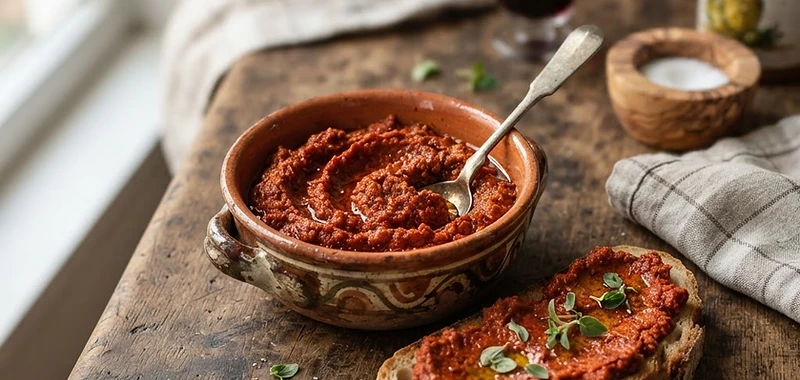
The cured meat that doesn't slice — it spreads. A fermented, spreadable pork sausage from Spilinga in Calabria, laced with local peperoncino (chili) until it's brick-red and ferociously hot. Melt it onto pizza, stir it into pasta, or eat it on bread. It's the taste of Calabria in a tube — spicy, porky, and unlike anything else in Italian cured meat. A little goes a long way.
Why go
To taste the spreadable, fiery sausage that puts Calabria on the food map.
The Field Guide take
'Nduja is the defining cured meat of Calabria, a region where the culinary philosophy prioritizes intensity and the utilization of every part of the animal. Originating from the province of Vibo Valentia, specifically the town of Spilinga, this spreadable, fermented pork sausage serves as the fiery counterpoint to the more restrained cured meats of Northern Italy. It is a product that challenges the conventional expectation that a salami should be firm enough to slice; 'nduja is soft, oily, and intensely hot.
What it is
'Nduja is a fermented pork sausage characterized by a remarkably high ratio of chili pepper to meat. Unlike traditional salumi that are cured to a point of firmness, 'nduja retains a paste-like consistency due to its significant fat content and the way it is processed. It is brick-red in color, owing to the massive quantity of local peperoncino (chili) integrated into the mixture. The flavor is a precise balance of savory, rich pork fat and a heat that develops slowly, coating the palate. It is a product designed to be spread rather than sliced.
Origin and history
The history of 'nduja is rooted in the tradition of cucina povera. In the Vibo Valentia area, as elsewhere in the Mediterranean, the goal was to avoid wasting any part of the slaughtered pig. While the choice cuts were often preserved as hams or firm salamis, the secondary cuts—specifically the meat from the shoulder and belly—were combined with the most abundant crop in the region: the Calabrian chili pepper.
While some etymologists suggest the name derives from the French andouille—a legacy of French occupation in the south—the product itself is definitively Calabrian in character. Historically, it was a practical means of preservation for households, but in recent decades, it has transitioned from a regional rural staple to a globally recognized ingredient.
How it’s made
The production process relies on the quality of two primary ingredients: pork and chili. The meat, typically a combination of belly and shoulder, is ground with a high concentration of roasted, dried Calabrian chili peppers. This mixture is then stuffed into natural casings.
Once encased, the sausages are subjected to a light smoking process, typically using woods native to the area, such as olive or acacia. The smoking is not intended to cook the meat but to provide a layer of flavor that complements the heat of the chilies. After smoking, the 'nduja is left to age for several months. The high fat content, combined with the presence of the capsaicin from the peppers, prevents the meat from hardening, resulting in the characteristic spreadable texture.
Where to eat it
To experience 'nduja in its most authentic form, one should look to the town of Spilinga. During the summer, the town hosts the Sagra della 'Nduja, a festival that functions as a deep dive into the local production. Throughout the province of Vibo Valentia and across the wider region of Calabria, 'nduja is ubiquitous. It appears in local trattorias as a standard antipasto or as an ingredient in complex sauces. If you are outside of Calabria, look for 'nduja sourced directly from producers in the Vibo Valentia area, as the specific variety and heat level of the Calabrian chili are difficult to replicate elsewhere.
When and how
'Nduja is available year-round. Because it is fermented and cured, it does not have a seasonal window of availability, though it is often consumed more frequently in cooler months when used in cooked dishes.
The most common way to serve it is at room temperature, spread generously over toasted, crusty sourdough bread. The residual heat of the toast helps soften the fat, making it easier to spread. In professional and home kitchens, 'nduja is frequently used as a foundational ingredient: a small spoonful stirred into a tomato sauce for pasta creates a deep, spicy depth that is difficult to achieve with dried chili flakes. On pizza, it is added sparingly; a little goes a long way, as the heat can quickly overwhelm other toppings.
What to drink with it
Because 'nduja is exceptionally fatty and piquant, it requires a beverage that can cut through the oil and stand up to the spice. A full-bodied, tannic red wine is the standard pairing. Specifically, a Cirò Rosso, produced from the Gaglioppo grape in Calabria, is the canonical choice. Its structure, moderate acidity, and dark fruit notes provide a necessary balance to the intensity of the sausage. Avoid delicate or high-alcohol white wines, which will likely clash with the heat and lose their profile against the bold flavor of the pork.
The Story
Where 'Nduja comes from
Nduja is a fiercely spicy, spreadable salami from the Vibo Valentia area of Calabria. It is a byproduct of the tradition of not wasting any part of the pig, blending meat with a high percentage of local chili peppers. It has gained widespread fame recently as the most explosive and savory cured meat in the Italian south.
What Defines It
Signature ingredients
Calabrian chili peppers
The engine of the flavor; they provide the heat and the bright red color.
Pork belly and shoulder
Provides the essential fat that allows the salami to remain soft and spreadable.
The Method
How it's made
The meat and peppers are ground together and stuffed into casings, then smoked gently and aged. The high fat and chili content keep it from hardening, resulting in a paste that melts when touched by heat.
Timing
When to eat it
Year-round.
Serve With
Classic pairings
Cirò Rosso
wineA robust southern red that matches the heat and depth of the peppers.
Sourdough bread
foodA toasted slice allows the fats to melt slightly, making it the perfect vehicle for the spread.
What makes it worth going
Spreadable, fiery fermented pork sausage from Calabria — the south's most explosive cured meat.
Things to do
- producer
An 'nduja producer in Spilinga
The home of the 'nduja, in the Calabrian hills. The pork, the hot pepper, the spread. Visit a producer; book ahead.
1.5 hrs
- trattoria
A Calabrian trattoria for 'nduja on crostini or pizza
The 'nduja is the starter on crostini, or the topping on pizza; the trattoria is the context. The heat is the test.
2 hrs
- salumeria
A Calabrian salumeria
In any Calabrian town, for 'nduja at different heat levels. The spread is the texture; the chili is the flavor.
1 hr
- experience
A Calabrian food day
'Nduja, caciocavallo, the Tropea onion, and a Cirò wine. The full Calabrian arc, with the heat as the thread.
Eat
- cured_meat
'Nduja di Spilinga
The classic: a spreadable, fermented pork salami from Spilinga, in Calabria, with hot Calabrian chili. The chili is the flavor and the color; the texture is the spread. The hottest of the Italian salumi.
- use
On crostini or pizza
The classic uses; the 'nduja is spread on crostini (toasted bread) or melted on pizza. The heat is the point.
- wine
A glass of Cirò or Greco di Bianco
The Calabrian red or white; the correct pairing for the heat.
Stay
- coastal town
Tropea or the Costa degli Dei
The Calabrian coast, near the Tropea onion and the Spilinga interior. A car is required.
- farm-stay
A Calabrian agriturismo
In the interior, where the 'nduja is made. A car is required.
Experiences Worth Booking
'Nduja producer visit and tasting
2 hrsThe pork, the chili, the spread, the tasting. The Calabrian heat is the context.
The 'nduja is spreadable and hot; a producer visit shows you the pork, the chili, and the spread.
Suits: Cured-meat lovers and heat-seekers who want the 'nduja at its source.
Calabrian food day
full dayAn 'nduja tasting, a caciocavallo lunch, a Tropea onion stand. The full Calabrian arc.
The 'nduja, the caciocavallo, and the onion are the Calabrian table; a day covers all.
Suits: Food travelers with a day for Calabria.
What's nearby & pairs with
More food from Calabria
Ready to plan?
Ready to turn discovery into a trip?
Italy Field Guide helps you decide where to go. When you're ready to build the actual day-by-day itinerary, take your saved places to Travel Itinerary Co — your interests go with you.
Turn your saved Italy places into a trip