The Verdict
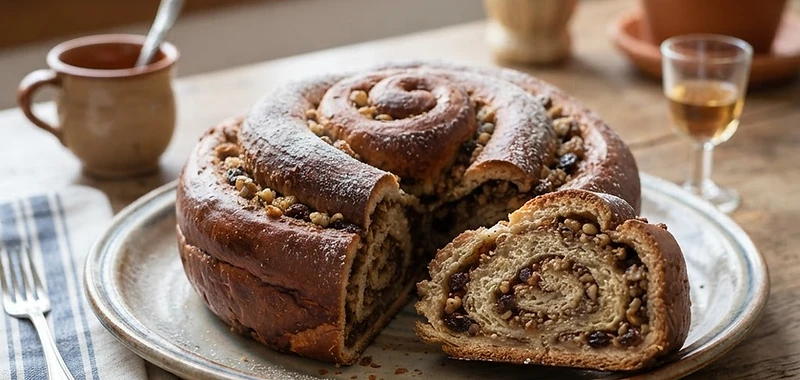
The cake of Friulian weddings and Christmas. A round of brioche dough, rolled thin, spread with a filling of walnuts, pine nuts, raisins, citrus zest, grappa, and sugar, then rolled, coiled, and baked — so the cut slice is a spiral. Eaten warm, in slices, with a glass of sweet wine. Slavic in origin (the name is Slovenian), and unlike any other Italian dessert.
Why go
To taste Friuli's spiral cake — nuts, grappa, and brioche, sliced into a spiral.
The Field Guide take
Gubana is a dense, coiled pastry that serves as the definitive festive dessert of the Natisone Valleys in northeastern Italy. Unlike the light, leavened panettone common to much of the country, this is a heavy, fruit-and-nut-laden loaf defined by its spiral cross-section. It is an artifact of the borderland culture where Friulian and Slovenian traditions meet, resulting in a cake that feels structurally and historically distinct from the Italian pastry canon.
The geography and history
The name gubana derives from the Slovenian word guba, meaning "fold" or "wrinkle," a direct reference to the cake’s tight, snail-like coil. While it is now associated with the town of Cividale del Friuli in the province of Udine, its origins are found in the folk traditions of the Slavic communities in the eastern Friulian hills. Historically, this was a milestone cake—baked for weddings, christenings, and religious feast days. It represents the pantry of a mountain region, relying on shelf-stable ingredients like walnuts, raisins, honey, and spirits, rather than the fresh butter and cream-based fillings found in the lowlands. Today, it is recognized as a Prodotto Agroalimentare Tradizionale (PAT), a designation that acknowledges its specific cultural heritage in Friuli-Venezia Giulia.
What it is
A finished gubana is a round, golden-brown loaf with a firm, thin crust. Its defining feature is the ratio of dough to filling. The base is an enriched brioche-style dough, rolled thin, spread heavily with a mixture of finely chopped walnuts, pine nuts, raisins, and citrus zest, then tightly coiled. The final product should be heavy for its size. When sliced, the spiral pattern of dark, moist filling against the light-colored dough is the mark of a well-executed pastry. If the dough is too thick or the filling too sparse, the texture suffers; a proper gubana must be moist and dense without being doughy.
Variations and companions
While the large, round gubana is the centerpiece of the table, you will often find strucchi alongside it. These are smaller, crescent-shaped pastries that use the exact same ingredients as the gubana. They are often eaten as a casual snack or served as a secondary treat when a full-sized loaf is more than the occasion requires. Within the Natisone Valleys, the recipes are closely guarded family secrets, though the Cividale style is generally recognized as being particularly walnut-forward.
How to eat it
Gubana is traditionally associated with Christmas and Easter, but because of its density and reliance on dried fruit and nuts, it keeps well and is produced throughout the year. It is best served sliced into thin wedges. While some shops sell the cake vacuum-sealed for transport, it is best eaten as fresh as possible. Many producers suggest warming the cake slightly in an oven before serving; this softens the crust and releases the aromatics of the grappa and citrus zest trapped within the filling.
The pairing
Because the cake is rich, boozy, and sweet, it requires a beverage with significant character. A glass of Picolit or Verduzzo, both of which are high-quality local sweet wines, is the classic choice; the acidity and honeyed notes of these wines cut through the dense walnut filling. Alternatively, a small glass of high-quality local grappa is the standard accompaniment in the Natisone Valleys. The heat of the spirit mirrors the notes of grappa folded into the pastry, emphasizing the rugged, mountain-born flavor profile of the dish.
Where to find it
To understand the dish, travel to Cividale del Friuli. This town serves as the unofficial hub for gubana production. Bakeries and specialty food shops throughout the town and the smaller villages of the Natisone Valleys will carry local versions. Avoid "supermarket" versions, which often substitute high-quality walnuts and natural fats with lower-grade alternatives and artificial flavorings. Look for loaves that feel dense and appear to have been hand-coiled, rather than mass-produced in a uniform mold.
The Story
Where Gubana comes from
Gubana originates from the Natisone Valleys, a borderland region in the province of Udine, Friuli-Venezia Giulia, where Italian, Friulian, and Slovenian cultures have long intersected. Its name derives from the Slovenian word 'guba,' meaning fold or wrinkle, which refers to the distinct coiled shape of the pastry. While often associated with the Cividale del Friuli area, its roots are deeply embedded in the folk traditions of the Slavic communities inhabiting the Eastern Friuli hills.
Historically, gubana was a cake prepared for major milestones, including weddings, christenings, and religious feast days. Unlike the airy pandoro or panettone of other regions, gubana reflects the ingredients available to rural mountain families: walnuts, honey, dried fruit, and a enriched dough. It has evolved from a rustic home-baked staple to a protected regional specialty, officially recognized as a Prodotto Agroalimentare Tradizionale (PAT) of Friuli-Venezia Giulia.
What Defines It
Signature ingredients
Walnuts
They form the structural and textural base of the filling, providing a characteristic bitterness that balances the sweetness of the raisins and sugar.
Grappa
Used to macerate the raisins and aromatics, it provides the essential boozy, herbaceous lift that distinguishes the cake from other nut-filled pastries.
Raisins
They introduce a chewy sweetness that contrasts with the dry, toasted profile of the walnuts.
Brioche-style dough
A rich, leavened dough that must be thin enough to allow for multiple spirals yet sturdy enough to contain a dense, heavy filling without tearing.
The Method
How it's made
A quality gubana is defined by the ratio of filling to pastry. The dough is rolled into a long, thin sheet and spread generously with a mixture of finely chopped nuts, dried fruits, sugar, and spirits. The key technique lies in the rolling and coiling; the dough must be tightly wound into a snail-like shape and placed in a circular mold, ensuring that every slice yields a clean, consistent spiral of dough and filling. A careless version often suffers from a dough that is too thick or a filling that is overly dry; an authentic version maintains a moist interior while the exterior achieves a deep golden-brown crust.
Across Italy
Regional variants
Cividale del Friuli
Often considered the unofficial capital of gubana; producers here emphasize a denser, more walnut-forward filling.
Strucchi
While not a large cake, these are small, crescent-shaped pastries made from the same dough and filling ingredients as gubana, traditionally eaten as a more casual snack.
Timing
When to eat it
Gubana is most traditionally served during the Christmas and Easter holidays, though it is now produced year-round and remains a staple at weddings and village festivals throughout the Natisone Valleys.
Serve With
Classic pairings
Picolit
wineA prestigious, rare local dessert wine from Friuli whose honeyed notes complement the richness of the walnuts.
Verduzzo
wineA classic Friulian dessert wine, often served slightly chilled, providing a crisp acidity to cut through the heavy filling.
Grappa
spiritA glass of local, unaged grappa is frequently served alongside or poured directly over the slice to enhance the spirit already present in the cake.
What makes it worth going
A spiral loaf of sweet brioche filled with nuts, raisins, and grappa — Friuli's festive cake.
Things to do
- pasticceria
A pasticceria in Cividale del Friuli
The home of the gubana, in the Natisone valleys. The dough, the dried fruit, the grappa. The pastry is the test.
1 hr
- bakery
A Slavic-Friulian bakery
The gubana is the Slavic-Friulian strudel; the bakery is the source. The dough is the spiral; the filling is the fruit.
1 hr
- festival
A Sagra della Gubana
The village festivals, where the gubana is baked in the square. The spiral is the show; the grappa is the smell.
full day
- experience
A gubana-making class
The dough is rolled, filled with dried fruit, nuts, and grappa, and rolled into a spiral. The technique is the roll.
Eat
- dessert
Gubana
The classic: a sweet bread dough, rolled with a filling of dried fruit (raisins, figs), nuts (walnuts, pine nuts), candied peel, and grappa or sliwowitz. The spiral is the shape; the slice shows the swirl.
- drink
With a grappa or sliwowitz
The Slavic-Friulian companion; the same spirit in the filling, in the glass.
- drink
A coffee
The Italian companion; the gubana is a coffee dessert.
Stay
- town
Cividale del Friuli
The base, in the Natisone valleys. Walkable; the pasticcerias are in the town.
- city
Udine or Trieste
The urban bases, with good pasticcerias and easier access.
Experiences Worth Booking
Gubana-making class
3 hrsThe dough, the dried fruit, the grappa, the spiral roll. The swirl is the technique.
The gubana is a spiral; a class shows you the dough, the fill, and the roll that makes the swirl.
Suits: Bakers who want the Slavic-Friulian dessert; the roll is the secret.
Slavic-Friulian food day
full dayA gubana tasting, a frico lunch, a sliwowitz tasting. The full Natisone valleys arc.
The gubana, the frico, and the sliwowitz are the Slavic-Friulian trinity; a day covers all.
Suits: Food travelers with a day for eastern Friuli.
What's nearby & pairs with
More food from Friuli-Venezia Giulia
Ready to plan?
Ready to turn discovery into a trip?
Italy Field Guide helps you decide where to go. When you're ready to build the actual day-by-day itinerary, take your saved places to Travel Itinerary Co — your interests go with you.
Turn your saved Italy places into a trip