
The Verdict
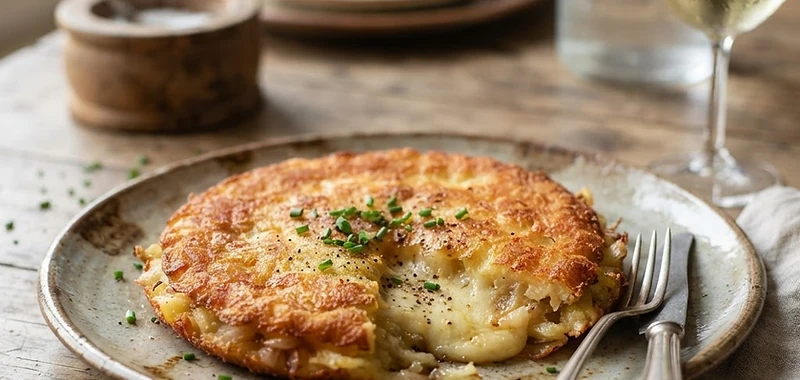
The cheese crisp that's the snack of Friuli. A pancake of grated Montasio cheese and potato (or just cheese), fried until the outside is a glass-shard crisp and the inside is still stretchy. Eaten hot, as an antipasto or a snack, with a glass of Friulano white. The crisp-only version (frico croccante) is a cheese wafer; the soft one (frico morbido) is the classic.
Why go
To taste the crisp cheese pancake — the Friulian snack you've never had.
The Field Guide take
Frico is a foundational element of the culinary identity of Friuli-Venezia Giulia. It is a preparation of Montasio cheese, often bound with potatoes, fried until the exterior forms a rigid, golden crust while the interior remains molten and elastic. It is, by design, an exercise in simplicity and energy efficiency, rooted in the alpine traditions of the region’s northern mountains.
What it is
Frico exists in two primary manifestations: frico morbido and frico croccante. The morbido version is a substantial, pancake-like disk made of grated potatoes, onions, and Montasio cheese. When executed well, it provides a textural contrast between a crisp, lacy crust and a soft, stretchy core. The croccante version is a brittle wafer consisting strictly of grated cheese, fried until the fat renders and the solids harden into a fragile, glass-like sheet. Both are expressions of the same ingredient—Montasio DOP—served as a warm, dense, and salt-forward staple.
History and origins
The dish originated in the Carnia region as a practical solution for alpine workers. It was a method of waste management: cheese makers and mountain laborers used the strissulis—the hard, dried-out rinds and fragmented remnants of Montasio that were otherwise inedible. By melting these scraps in a pan, they transformed otherwise discarded material into a portable, calorie-dense meal suitable for long days in the high pastures.
References to the dish appear as early as the 15th century in the writings of the chef Maestro Martino. While the ingredients are modest, the dish served a vital function in a harsh climate. Over centuries, the morbido version incorporated local potatoes, a logical addition that stretched the supply of expensive cheese while adding bulk to the meal.
How it's made
The preparation of frico morbido requires careful heat management. Boiled, grated potatoes are traditionally sautéed with onions before being combined with a high proportion of grated, medium-aged Montasio. The mixture is pressed into a flat, circular shape in a heavy, non-stick pan. The cook must regulate the heat to brown the exterior evenly without scorching the cheese or leaving an excess of rendered oil in the pan. A finished frico should be golden and structurally sound, allowing it to be sliced into wedges without falling apart.
Frico croccante is technically simpler but less forgiving. It requires placing small mounds of aged, grated cheese into a hot pan. As the cheese melts and the fat separates, it forms a thin, crisp disk. The timing is critical; if pulled too early, it is greasy and limp; if left a few seconds too long, the flavor turns bitter.
Where to eat it
The dish is ubiquitous in the mountainous north, specifically throughout the Carnia district. In these rural villages, frico morbido is often a primary course, served in generous, rustic portions. In urban centers like Udine, the presentation is frequently more restrained. Here, it is often served as an antipasto or a snack alongside local wines. Travelers will find that the quality of the dish is tied directly to the quality of the Montasio used; look for establishments that prioritize DOP-certified, aged cheeses rather than generic, mass-produced versions.
When and how
While available year-round, frico is most appropriate in autumn and winter. It is heavy, rich, and designed to provide thermal and caloric comfort. It is traditionally served with polenta, which acts as a neutral base to balance the intensity of the fried cheese. It is served hot; once it cools, the texture of the frico morbido becomes rubbery and the frico croccante loses its brittle integrity.
What to drink with it
The salt and fat content of the cheese requires a wine with sufficient acidity or tannin to cleanse the palate. Friulano (formerly known as Tocai Friulano) is the standard white wine pairing; its characteristic almond notes and medium body cut through the density of the potato and cheese. For those who prefer red, a Refosco dal Peduncolo Rosso provides the necessary acidity and astringency to contrast the richness of the fried fat. Avoid light, delicate whites, which will be completely overwhelmed by the intensity of the cheese.
The Story
Where Frico comes from
Frico traces its origins to the peasant kitchens of the Carnia region in the Friuli-Venezia Giulia mountains. Historically, it emerged as a method of food conservation and waste reduction, specifically designed to utilize the cheese scraps (the rinds and broken bits of Montasio) that were too hard to eat raw. By melting these remnants in a pan, mountain workers could create a portable, energy-dense meal that sustained them during long shifts in the alpine pastures or forests. Originally a humble, solitary dish for the working class, it has evolved into the defining culinary symbol of the Friulian identity. While the exact timeline of its invention is difficult to pinpoint, references to frico appear in medieval manuscripts, including a recipe attributed to Maestro Martino, a 15th-century chef, confirming its deep roots in Northern Italian foodways. It reflects the stoic, practical nature of Friulian mountain culture, turning limited mountain resources into a satisfying, caloric staple.
What Defines It
Signature ingredients
Montasio DOP
The primary ingredient; a semi-hard cow's milk cheese that provides the essential balance of fat and salt. Aged Montasio is preferred for a sharper, nuttier profile.
Potatoes
Used in the 'morbido' version to bind the cheese, adding a soft, starch-driven texture that offsets the intensity of the molten dairy.
Onions
Optional but traditional, these provide a sharp, sweet aromatic element that cuts through the heavy fat content of the cheese.
Lard or Butter
The traditional frying medium used to ensure even browning and to provide a consistent base for the crust to develop.
The Method
How it's made
A well-made frico requires precise heat management. For the soft version, potatoes are boiled, grated, and sautéed with onions before being folded into generous amounts of grated Montasio. The mixture is pressed into a flat, pancake-like shape in a non-stick pan and fried. The hallmark of a quality frico is the exterior 'crust'—it must be golden, uniform, and stable enough to hold the interior together, which should remain molten and elastic. A careless version often suffers from uneven browning, burnt cheese edges, or excessive residual grease, which masks the clean, nutty flavor of the Montasio. The 'croccante' (crisp) version is made simply by frying piles of aged grated cheese until it forms a thin, wafer-like disk, requiring constant attention to prevent it from becoming bitter.
Across Italy
Regional variants
Carnia
The birthplace of the dish where the potato-heavy 'morbido' version is the absolute standard and considered a hearty main course.
Udine
In the urban centers, the dish is frequently served as a polished antipasto, often featuring more refined presentation and varied cheese aging levels.
Timing
When to eat it
Frico is a year-round staple of Friulian mountain cuisine, though it is most sought after during the cooler autumn and winter months when its caloric density and warmth are most appropriate for the climate.
Serve With
Classic pairings
Friulano
WineA local white wine with high acidity and floral notes that provides necessary contrast to the richness of the fried cheese.
Polenta
FoodA traditional side, usually served soft, which serves as a neutral vessel for the salt-forward frico.
Refosco dal Peduncolo Rosso
WineA robust local red wine that stands up to the salty intensity of mature Montasio.
What makes it worth going
Crisp Montasio cheese and potato pancake — Friuli's great cheese snack, with a stretchy middle.
Things to do
- trattoria
A trattoria in Carnia or Tolmezzo
The home of the frico, in the Friulian Alps. The cheese, the potato, the crisp. Reserve; the trattorias are small.
2 hrs
- festival
A frico festival (e.g. Carnia, summer)
The village festivals, where the frico is made in the square. The Montasio cheese is the test; the crisp is the show.
full day
- producer
A Montasio cheese producer
The frico is made with Montasio, the Friulian cow's milk cheese. Visit a producer; the age is the taste. Book ahead.
1.5 hrs
- experience
A frico-making class
The frico is the lesson; the cheese, the potato, the crisp. The technique is the melt and the fry.
Eat
- snack
Frico (croccante)
The classic: a crisp cheese wafer, made by frying Montasio cheese until it's golden and lacy. The snack version; the crisp is the whole.
- dish
Frico (con patate)
The soft version: Montasio cheese with potatoes, onions, and sometimes pancetta, cooked into a cake. The richer dish; the potato is the base.
- wine
With a glass of Friulano or Schioppettino
The Friulian white or red; the correct pairing for the cheese and the fry.
Stay
- city
Udine or Tolmezzo
The Friulian bases, with good trattorias and easier access. A car is useful.
- rifugio
An alpine rifugio in Carnia
For hikers; the frico is the refuel. A hike is required.
Experiences Worth Booking
Frico-making class
2 hrsThe Montasio, the potato, the melt, the fry. The crisp is the technique.
The frico is a cheese fry; a class shows you the melt, the potato, and the crisp.
Suits: Cheese lovers who want the Friulian classic; the melt is the secret.
Friulian food day
full dayA frico lunch, a prosciutto di San Daniele tasting, a Friulano cellar. The full Friulian arc.
The frico, the prosciutto, and the Friulano are the Friulian trinity; a day covers all.
Suits: Food and wine travelers with a day for Friuli.
What's nearby & pairs with
More food from Friuli-Venezia Giulia
Ready to plan?
Ready to turn discovery into a trip?
Italy Field Guide helps you decide where to go. When you're ready to build the actual day-by-day itinerary, take your saved places to Travel Itinerary Co — your interests go with you.
Turn your saved Italy places into a trip