The Verdict
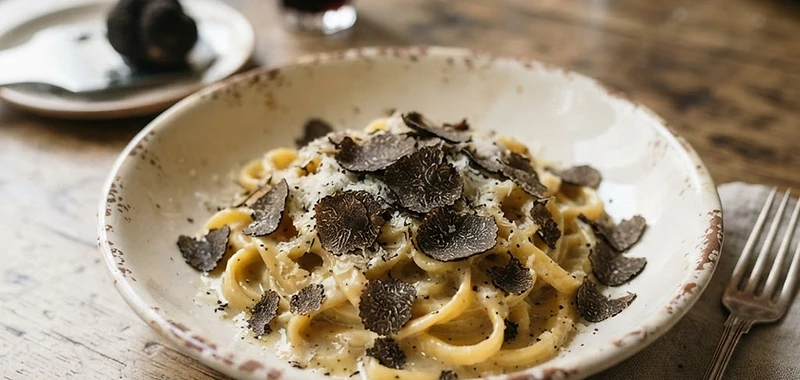
The dish that proves black truffle doesn't need white truffle's fame. Long egg pasta (tagliolini or strangozzi), butter, a generous shave of the black summer or winter truffle of Norcia, and a little Parmigiano. Nothing else. The black truffle is more subtle than the white — earthier, less perfumed — but in Umbria, where it's grown, it's the whole dish. Eat it in a Norcia trattoria, in season, with a Sagrantino.
Why go
To taste the black truffle, plainly, on pasta — in Norcia, where it's from.
The Field Guide take
In the forests of the Sibillini Mountains, the black truffle is not a luxury accessory, but a staple of the local landscape. In the towns of Norcia and Spoleto, Pasta al Tartufo is the defining dish of the region. It is a preparation that ignores culinary artifice, relying entirely on the quality of the egg pasta and the integrity of the winter harvest.
What it is
Pasta al Tartufo is a straightforward assembly: fresh egg pasta, butter, and a generous quantity of shaved black truffle (Tuber melanosporum). Unlike the white truffles of Alba, which command attention with an aggressive, pungent perfume, the black truffle of Umbria is earthy and subtle. It is a dish that does not aim to overwhelm the palate, but rather to ground it in the flavors of the Valnerina valley. When executed correctly, there are no heavy creams, no garlic, and—most importantly—no synthetic truffle oils. The dish is a measure of the cook’s restraint.
Origin and history
The dish is a product of the Sibillini forests and the centuries-old foraging traditions of the Valnerina. Norcia has long been defined by its two primary food pillars: norcineria (the art of pork butchery) and the wild harvest. While truffle markets in other parts of Italy have become heavily commercialized, the Umbrian tradition remains tied to the local forest floor. Families here have long gathered truffles with trained dogs, an activity that remains central to the region’s cultural identity. Historically, Pasta al Tartufo was a way for forest communities to feature the seasonal harvest without obscuring its flavor, reflecting a peasant-influenced culinary philosophy that prioritizes raw ingredients over complex technique.
How it's made
The success of the dish depends on thermal control and timing. The pasta—typically strangozzi, a thick, hand-rolled noodle made of flour and water, or egg-rich tagliolini—is boiled until just firm. In a separate pan, butter is melted gently; it should remain pale and liquid, never browned.
The pasta is tossed in the butter, with a small amount of starchy pasta water added to bind the fat into a light, glossy coating. The truffles are never cooked in the pan, as heat destroys their delicate volatile compounds. Instead, they are shaved onto the plate the moment it is served. The heat radiating from the pasta is sufficient to release the truffle's aroma. If a restaurant serves the dish with a heavy cream sauce or the pervasive scent of garlic and truffle oil, it is not a traditional preparation.
Where to eat it
The definitive version of this dish is found in the provinces of Norcia and Spoleto. In Norcia, you will find it prepared with a nod to the local butchery, sometimes finished with a touch of rendered guanciale or local lard to deepen the earthiness of the truffle. In Spoleto, the preference leans toward thinner, more delicate pasta, which allows the aroma of the truffle to coat the strands more evenly. Seek out family-run trattorias in these two towns during the winter months. If the price seems remarkably low, be aware that you are likely paying for artificial flavoring; genuine black truffles carry a market price that makes the dish an investment.
When and how
The definitive season for the Tuber melanosporum (the black winter truffle) is December through March. While summer truffles (Tuber aestivum) are available in the warmer months, they lack the depth and aromatic intensity of the winter harvest. To experience the dish at its peak, visit Umbria in the dead of winter. It is a dish meant to be eaten with a fork and a singular focus—it is not an appetizer, but the primary event of the meal.
What to drink with it
Because the truffle is earthy rather than acidic or spicy, the pairing should respect its weight. A glass of Montefalco Sagrantino is the traditional choice; it is a tannic, powerful red wine that stands up to the richness of the butter and the density of the truffle. For those who prefer a white wine, a local Grechetto offers enough mineral complexity to complement the dish without clashing with the subtle musk of the tuber. Regardless of the choice, avoid light, acidic wines that will struggle to hold their own against the heavy, fat-forward nature of the pasta.
The Story
Where Pasta al Tartufo comes from
Pasta al Tartufo is deeply rooted in the agricultural traditions of the Valnerina valley in Umbria, particularly around the towns of Norcia and Spoleto. Unlike the commercially driven truffle markets of Piedmont, the Umbrian truffle tradition is born from the local landscape where the black winter truffle (Tuber melanosporum) grows wild in the beech and oak forests surrounding the Sibillini Mountains. Historically, the dish emerged as a way to feature the harvest of the season without the need for complex sauces that would mask the ingredient's aromatic profile.
The dish serves as a culinary pillar for Norcia, a town historically known for its mastery of pork butchery and wild foraging. While black truffles are now cultivated, the practice of gathering them with trained dogs remains a cultural identity for local families. The simplicity of the pasta—pairing high-fat, high-egg content noodles with the earthy aroma of the truffle—reflects a peasant-influenced culinary philosophy that prioritizes ingredient quality over technical elaboration.
What Defines It
Signature ingredients
Black Winter Truffle (Tuber melanosporum)
The primary aromatic agent; provides a deep, musky, and earthy flavor profile that is less aggressive than white truffles.
Strangozzi
A hand-rolled, long egg-less pasta local to Umbria that has a chewy, dense texture, holding up to the weight of the truffle shavings.
High-fat butter
Acts as a carrier for the truffle oils; a good quality cultured butter is essential to bind the pasta without drowning the truffle flavor.
Parmigiano Reggiano (aged 24 months)
Used in moderation to add a savory depth (umami) that complements the truffle, though it should never overpower it.
The Method
How it's made
The process is defined by thermal control. The pasta is boiled in salted water until al dente. In a separate pan, butter is gently melted—never browned. The key technique involves emulsifying the cooked pasta with the butter and a splash of starchy pasta water to create a light, glossy coating. The truffles are shaved fresh over the finished plate at the very last second. A common mistake in inauthentic versions is the use of truffle oil; true Pasta al Tartufo relies exclusively on the heat of the pasta to release the natural oils of the fresh shaved truffle.
Across Italy
Regional variants
Norcia
Often adds a touch of local cured lard or guanciale, which complements the earthiness of the black truffle with rendered animal fat.
Spoleto
Frequently uses slightly thinner pasta, similar to tagliolini, to allow for more delicate integration of the truffles.
Piedmont
While less common, when this dish is prepared here, it is often done with the much more pungent white truffle and a heavier emphasis on a creamy egg yolk emulsion.
Timing
When to eat it
Black winter truffles (Tuber melanosporum) are in season from December through March. Summer truffles (Tuber aestivum) appear in the warmer months but are lighter in aroma; the definitive version of the dish is synonymous with the winter months.
Serve With
Classic pairings
Montefalco Sagrantino
wineA bold, tannic Umbrian red that stands up to the intense earthiness of the truffle.
Grechetto
wineAn Umbrian white wine with enough acidity and structure to cut through the butter without clashing with the truffle aromatics.
Pecorino di Norcia
other foodOften served as a preceding antipasto to prepare the palate for the richer truffle main course.
What makes it worth going
Egg pasta with black truffle and nothing else — the dish of the Umbrian truffle country.
Things to do
- ristorante
Granaro del Monte (Norcia)
The historic Norcia ristorante, since 1894. The pasta al tartufo nero is the benchmark; in winter, the black truffle is shaved generously. Reserve.
2 hrs
- trattoria
Trattoria del Borgo (Spoleto)
In the upper town. The black truffle pasta in season; the strangozzi is hand-cut.
2 hrs
- market
Norcia truffle market (Feb / Nov)
The town's black truffle fairs, in late winter and autumn. The truffles are weighed and sold; the streets fill with sellers and cooks.
half day
- experience
A truffle hunt in the Valnerina
The mountains around Norcia are black truffle country. A hunt with a trifulau and a dog; the black truffle is earthier, deeper, less perfumed than the white.
Eat
- pasta
Tagliolini al tartufo nero
The classic: thin egg pasta, butter, and a generous shave of Norcia black truffle. Nothing else — the truffle is the dish.
- pasta
Strangozzi al tartufo
The Umbrian hand-cut long pasta, with black truffle. Thicker than tagliolini, more rustic.
- side
Lenticchie di Castelluccio
The tiny Castelluccio lentils, with a drizzle of oil. The other Norcia specialty; pair with the truffle.
Stay
- town
Norcia
The truffle and pork capital of Umbria. The 2016 earthquake damaged the center, but the town is back; stay in or near the walls.
- town
Spoleto
A more intact base, 40 min from Norcia; the truffle and the pasta are as good, the architecture more complete.
- rural
A Valnerina village
In the mountains, among the truffle woods. The most remote and beautiful base; a car is required.
Experiences Worth Booking
Black truffle hunt in the Valnerina
3-4 hrsA dawn walk with a truffle hunter and dog, in the Norcia woods. Find a black truffle; lunch after.
The black truffle is earthier than the white; the hunt shows you why it's a different, deeper food.
Suits: Anyone in Umbria in autumn or winter; the most authentic truffle experience here.
Sagrantino di Montefalco cellar day
full dayVisits to two or three cellars in Montefalco, with tastings. The Umbrian red that pairs with the truffle.
The truffle and the Sagrantino are the Umbrian pairing; a cellar day is the other half.
Suits: Wine lovers who want the Sagrantino pilgrimage.
What's nearby & pairs with
More food from Umbria
Ready to plan?
Ready to turn discovery into a trip?
Italy Field Guide helps you decide where to go. When you're ready to build the actual day-by-day itinerary, take your saved places to Travel Itinerary Co — your interests go with you.
Turn your saved Italy places into a trip