The Verdict
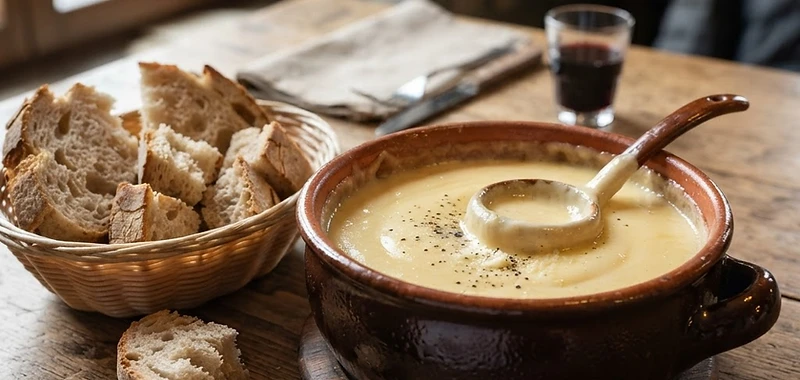
The Italian fondue, and the dish that proves Fontina is a melting cheese. Fontina, melted slowly with milk, butter, and egg yolks, until smooth and glossy, served in a communal pot, for dipping cubes of crusty bread. Unlike the Swiss version, no wine, no kirsch — just cheese, milk, and egg. The cold-weather dish of the Valle d'Aosta, eaten in a mountain rifugio, after a day in the snow.
Why go
To dip bread in melted Fontina, in a Valle d'Aosta rifugio, in winter.
The Field Guide take
Fonduta Valdostana is the primary culinary output of the Valle d’Aosta, the high-altitude region pinned between the borders of France and Switzerland. It is a dish born of necessity and topography: a method to consume Fontina cheese during the long, inaccessible winter months. Unlike its neighbors across the border, the Valdostana preparation relies on the richness of eggs rather than the acidity of wine to achieve its characteristic texture, creating a dense, savory cream that serves as the cornerstone of regional mountain culture.
What it is
At its most fundamental level, Fonduta Valdostana is an emulsion of Fontina DOP cheese, milk, and egg yolks. While often confused with the Swiss fondue due to the communal nature of the serving vessel, the similarity ends at the use of melted cheese. A proper fonduta should be smooth, glossy, and thick enough to coat the back of a spoon. It is not intended to be a light snack; it is a high-calorie, dense preparation designed to provide warmth and sustenance after time spent in the snow-covered valleys surrounding Mont Blanc and the Gran Paradiso.
Origin and history
The dish reflects the pastoral history of the Aosta Valley. For centuries, the summer months were dedicated to moving herds to high-altitude pastures, where raw milk was turned into Fontina—a semi-hard cow’s milk cheese aged in the valley's damp, cold mountain caves. During the harsh winters, when fresh food was scarce, aged Fontina became the primary source of protein and fat. The transition from a simple melted cheese to a refined egg-based emulsion evolved as a way to stretch the cheese and create a more satisfying meal for families and mountain workers. Its survival as a regional staple is a direct result of the valley's isolation, which allowed a distinct, localized food culture to persist without the influence of neighboring Alpine trends.
How it's made
Preparation requires precise temperature control. To begin, cubes of Fontina are soaked in milk for several hours to soften the proteins. The mixture is then placed in a bain-marie (a double boiler) over low, gentle heat. Direct flame is avoided, as extreme temperatures cause the fats to separate from the cheese, resulting in a gritty, broken sauce. Once the cheese has melted into a uniform base, butter and raw egg yolks are whisked in. The whisking is constant and vigorous to ensure the emulsion holds. A well-made fonduta is uniform; if you see oil pooling on the surface or clumpy protein strands, the technique has failed.
Where to eat it
The most authentic way to experience the dish is in an albergo or rifugio located in the higher reaches of the Valle d'Aosta. In these settings, it is often served as a main course, frequently poured over squares of grilled polenta rather than kept in a communal pot for dipping. In the lower valley towns, particularly around Aosta, you may find it served in the traditional style with crusty artisan bread. In the autumn, some establishments add shaved white truffles to the base. While the combination is widely accepted, it is a luxury addition; the standard, unadorned version remains the baseline for quality.
When and how
Fonduta is strictly a cold-weather dish. It appears on menus from late autumn through early spring, coinciding with the ski season. Ordering it during the summer months is generally discouraged by local hosts, as the dish is fundamentally designed for cold-climate recovery. When served, eat it immediately while it remains hot. It is often accompanied by boiled potatoes or crusty bread, both of which act as neutral vessels for the intense richness of the cheese.
What to drink with it
To balance the high fat content of the cheese and eggs, the drink pairing must have enough acidity and structure to cleanse the palate. Local red wines from the Valle d’Aosta, such as Torrette or those made from the Fumin grape, are the standard choices. These wines are often high-altitude, lean, and possess enough grip to cut through the creaminess of the fonduta without being overwhelmed. Avoid heavy, high-tannin wines from lower-lying regions, as they tend to clash with the delicate, savory profile of the melted Fontina.
The Story
Where Fonduta Valdostana comes from
Fonduta Valdostana is the defining culinary output of the Valle d'Aosta, Italy's smallest and most mountainous region. It emerged from the pastoral traditions of high-altitude dairy farming, where the abundance of raw milk in the summer months necessitated the production of Fontina, a semi-hard cow's milk cheese that matures in the valley’s cold, damp caves. The dish is a reflection of the harsh Alpine winters; historically, it was a way to consume aged cheese and provide high-calorie sustenance to families during periods when fresh produce was unavailable.
While often compared to Swiss fondue, the Valdostana preparation is distinct in its lack of wine or spirits. Its origin is deeply intertwined with the rural economy of the Gran Paradiso and Mont Blanc valleys. It serves as a social pillar of the region's mountain culture, traditionally served in communal fashion to bring warmth after long days in the snowy high pastures.
What Defines It
Signature ingredients
Fontina Valdostana DOP
The essential base; must be the authentic Alpine version, which offers a unique nutty, earthy flavor profile and superior melting properties.
Full-fat milk
Used to create the emulsion base that thins the cheese and ensures a creamy, pourable consistency rather than a stringy texture.
Egg yolks
Added at the end to thicken the sauce and provide a rich, velvet finish that prevents the cheese from separating.
Crusty artisan bread
Specifically firm, sourdough or rustic wheat loaves are required to stand up to the weight of the cheese without dissolving.
Butter
Used in moderation to enhance the mouthfeel and ensure a glossy, smooth final appearance.
The Method
How it's made
The process requires patience and temperature control. The Fontina is diced finely and soaked in milk for several hours to soften. This mixture is then gently heated in a bain-marie—never directly over high flame—to prevent the cheese from seizing or becoming oily. Once melted, butter and raw egg yolks are whisked in vigorously until the mixture is uniform and coats the back of a spoon. A well-made fonduta is smooth, glossy, and holds its heat; a careless version is often broken, where the fat has separated from the proteins, resulting in a gritty or clumpy sauce.
Across Italy
Regional variants
Aosta Valley lowlands
Sometimes includes the addition of shaved white truffles during the autumn months to provide an aromatic depth to the creamy base.
Mountain Rifugi
Often served poured over grilled polenta squares rather than as a communal dip, serving as a more substantial main course.
Timing
When to eat it
This is strictly a cold-weather dish, typically served from late autumn through early spring. It is the definitive post-skiing or winter-hiking meal in the Valle d'Aosta.
Serve With
Classic pairings
Torrette
wineA regional red wine from the Aosta Valley that provides enough acidity and structure to cut through the intense creaminess of the cheese.
Fumin
wineAn indigenous high-altitude red grape variety that balances the richness of the fondue with its characteristic tannins.
Boiled potatoes
other foodA common side served alongside the bread, providing a neutral, earthy contrast to the salt-forward cheese.
What makes it worth going
Melted Fontina and egg yolk fondue, for dipping bread — the Alpine fondue, Italian style.
Things to do
- trattoria
A Valdostan trattoria in Aosta or Courmayeur
The home of the fonduta, in the alpine valleys. The fontina, the egg yolk, the truffle. Reserve; the trattorias are cozy.
2 hrs
- rifugio
A rifugio on the high pastures
The fonduta at altitude, after a hike. The melted cheese is the refuel; the view is the bonus.
half day
- producer
A fontina producer
The fonduta is made with fontina; the producer is the source. Visit a cellar; the cheese is the base. Book ahead.
1.5 hrs
- experience
A fonduta-making class
The fonduta is the lesson; the fontina, the egg yolk, the milk, the melt. The technique is the emulsion.
Eat
- dish
Fonduta valdostana
The classic: melted fontina cheese, with egg yolks, milk, and (sometimes) a little truffle. The alpine fondue; the cheese is the dish. Eaten with bread or polenta.
- dipper
With pane or polenta
The companions; the bread or the polenta is dipped in the melted cheese. The fonduta is the sauce.
- wine
A glass of Fumin or Torrette
The Valdostan red; the correct pairing for the cheese and the melt.
Stay
- city
Aosta or Courmayeur
The urban bases, with good trattorias and easier access. A car is useful.
- rifugio
A high-pasture rifugio
For hikers; the fonduta is the refuel. A hike is required.
Experiences Worth Booking
Fonduta-making class
2 hrsThe fontina, the egg yolk, the milk, the melt. The emulsion is the technique.
The fonduta is an emulsion; a class shows you the fontina, the egg yolk, and the stir.
Suits: Cheese lovers who want the alpine fondue; the melt is the secret.
Valdostan food and mountain day
full dayA fontina producer, a fonduta lunch, a mountain-view hike. The full Val d'Aosta arc.
The fontina, the fonduta, and the mountains are the Valdostan trinity; a day covers all.
Suits: Food and mountain travelers with a day for the Alps.
What's nearby & pairs with
More food from Valle d'Aosta
Ready to plan?
Ready to turn discovery into a trip?
Italy Field Guide helps you decide where to go. When you're ready to build the actual day-by-day itinerary, take your saved places to Travel Itinerary Co — your interests go with you.
Turn your saved Italy places into a trip